Why choose an IPS TFT LCD?
TN panels can show grayscale inversion or color shift from certain directions. IPS technology provides wider viewing angles and more stable color, which is valuable when several users view an HMI or when the installation angle changes.
Why specify high brightness?
High-brightness backlights support readability in strong ambient light. The correct luminance target should be evaluated with contrast, surface reflection, power consumption and temperature rise. For direct-sunlight projects, review the complete sunlight-readable TFT LCD design, not only the nominal nit value.
What is optical bonding?
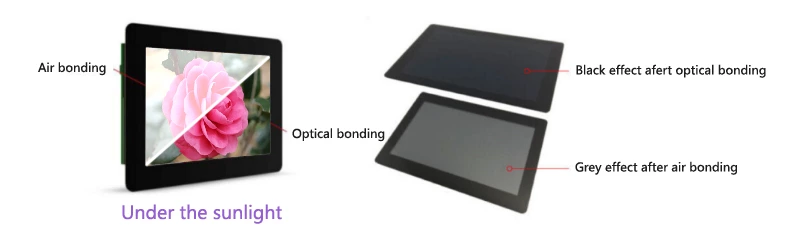
Optical bonding uses an optically clear adhesive to join the TFT LCD to a touch panel or protective cover glass. Removing the air gap reduces internal reflections, improves perceived contrast and adds mechanical support. Adhesive selection and the bonding process must match the display size, temperature range and reliability requirement.
Why use an industrial PCAP controller?
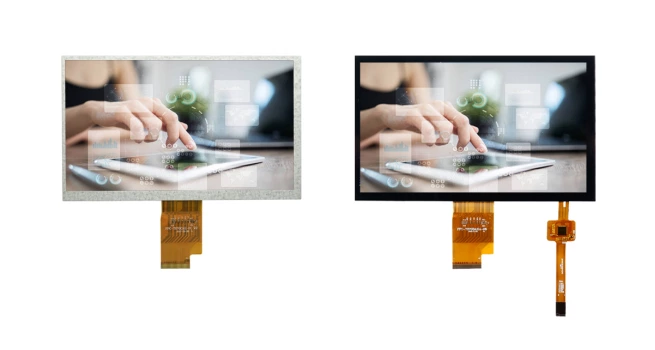
Industrial projected-capacitive touch systems can be tuned for thick cover glass, gloves, water rejection and electromagnetic conditions. Controller selection, sensor pattern, cover geometry, firmware and grounding must be developed together. Explore DISEA's custom PCAP TFT LCD options.
Important touch-screen design points
- Cover-glass thickness, shape, printing and surface treatment
- Impact target and enclosure support
- Glove and wet-touch requirements
- Number of simultaneous touch points
- EMC, ESD and conducted-immunity requirements
- Optical bonding, gasket and mechanical tolerance stack
For a combined module, provide the intended cover-lens drawing, operating environment, host interface and touch behavior. This allows the display and touch stack to be evaluated as one assembly.
The 3.5-inch 320×480 IPS module is a practical product-page reference; DISEA can also evaluate a PCAP or bonded ODM configuration.
Discuss your touch requirement